 Megan Navarro

AUSTIN — The possibility of the Barton Springs Edwards Aquifer Conservation District (BSEACD) declaring a Stage 4 Emergency Response Period is looming close to a reality, if groundwater conditions continue to remain at historic low levels.
This would be the first time in the district’s 39-year history that it would call for a Stage 4, but it has been operating under Stage 3 Exceptional Drought since October 2025 and, as of February 2026, has remained in continuous drought for 44 consecutive months. The state of Texas’ drought of record is the one that occurred in the 1950s and, while the current drought has not been as long as that one, it has been very intense, explained BSEACD communications and outreach manager Shay Hlavaty.
“While this drought has been a little bit shorter, it's been more intense. This current drought is approaching potentially being our new drought of record and so, that's definitely huge news and definitely something to be concerned about,” Hlavaty said. “The last four years, we've been getting below average rainfall year after year.”
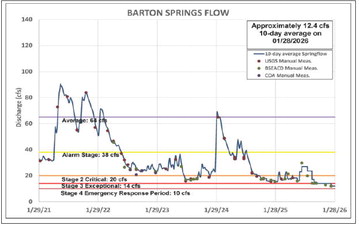
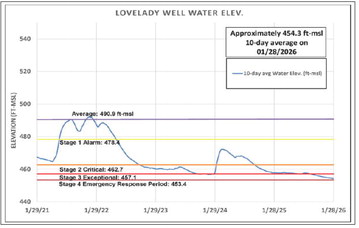
BSEACD determines the drought stages by using the 10-day average of two primary indicators: groundwater levels at the Lovelady Monitor Well in the Edwards Aquifer and flow rates at Barton Springs.
Lovelady has data going back to 1949 since before the drought of record, which differs from a lot of wells that don’t have that extensive amount of historic information. A lot of wells that are located in the Trinity Aquifer, Hlavaty explained, have only been monitored since the early 2000s.
Additionally, Lovelady does not respond quickly to rain events, as compared to Barton Springs — which will show increased flow soon after the area receives precipitation. Lovelady could take two weeks until the district sees the full response.
As of Jan. 28, the 10-day average at Barton Springs is at 12.4 cubic feet per second and Lovelady is at 454.3 feet above average sea level, both of which are very close to the cutoff of moving into Stage 4.
“The way I describe it is that a cubic foot is about the amount of water it would take to fill up an average beach ball and so, only about 12 beach balls per second worth of water are coming out of Barton Springs right now and average is over 60 cubic feet per second. So, we're at less than a quarter of what average flow should be at Barton Springs,” Hlavaty said. “There's average sea level, or mean sea level, and so, it's 454 feet above that … [the] average is 490.9 feet mean sea level; that’s like almost 40 feet difference, which is significant.”
While the district only looks at Lovelady and Barton Springs when determining drought, it also monitors more than 50 wells across its territory — from south Austin down to San Marcos — as well as the Hays Trinity Groundwater Conservation District in western Hays County. In doing so, it has seen similar declines and record, alarming lows in the Trinity and Edwards aquifers.
Now, because both of the indicators are getting close to approaching the threshold, the district could declare Stage 4 as early as late March. Whenever either Lovelady or Barton Springs fall below their set threshold for a drought stage, BSEACD has the ability to declare drought; only one of the drought indicators has to reach that level, but in order to get out of it, they both have to rise above their set threshold, Hlavaty said.
If the district were to move to Stage 4, Hlavaty explained that people with permits with BSEACD would experience increased curtailments and restrictions on the amount of water they can use.
“We have thousands of people who rely on a domestic well at their house. Folks may start experiencing not being able to get water out of their well. It's very likely not that their well is actually ‘dry,’ it's probably more so that the water has dropped below their pump and so they, in most cases, can lower it and access water again,” she said. “It's significant that our water levels are reaching this low, while demand is still similar to what it was when we were out of drought.”
Also, board members, who are also elected officials, are given more ability to implement adjustments and changes as they see fit to protect the water resources, Hlavaty noted. The district is working with the board to develop a plan and needed actions in case this takes place, “so we can do whatever the district thinks is necessary to preserve water resources for the long term for all the people in our district who rely on the groundwater,” she said.
Residents, especially well owners and those who rely on water providers in the area, should know that they can help conserve by not watering their lawns outside, even in the winter. Up to 70% of water consumption, Hlavaty said, is recorded to be just outside water use in a lot of communities.
“It’s really important just to take a moment and notice how precious our water resources are and really contemplate how we are using it,” she said.
To learn more about BSEACD and stay up-to-date on the drought status, visit www.bseacd.org.