 Ashley Kontnier
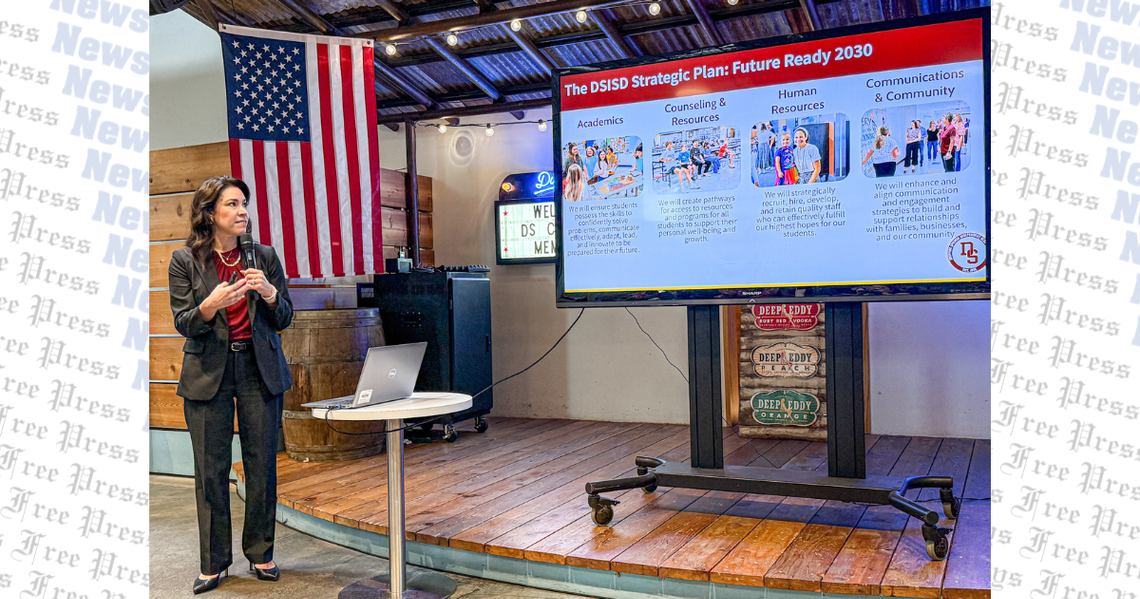
DRIPPING SPRINGS — Representatives from Dripping Springs ISD provided community members with the annual State of the District presentation at the Dripping Springs Chamber of Commerce Luncheon Wednesday, April 22, which was held at the Deep Eddy Vodka Tasting Room.
Superintendent Dr. Holly Morris-Kuentz began the program by sharing the progress of The DSISD Strategic Plan: Future Ready 2030.
“Two years ago, we entered into strategic planning, which was a yearlong endeavor for us,” she said. “The focus of that really was to bring our community in and make sure that as we were moving forward as a district, we were moving forward with our community and really thinking about what did our community need from their school system.”
The goals, the superintendent explained, centered around academics, counseling and resources, human resources — taking care of staff — connecting with the community and improving communications, which the district has focused on for the last two years.
In the first year — the 2024-25 school year — there was an emphasis on curriculum. This effort worked to ensure consistent alignment of course offerings across all campuses and establish a clearly defined curriculum for all courses.
Academic goals for year two include providing students with authentic opportunities to solve problems and develop academic, technical and interpersonal skills.
Another area of focus in year one was a comprehensive counseling and advising framework. This allowed the district to focus on interventions for students in year two, said Morris-Kuentz.
The final accomplishment in year one was establishing a comprehensive hiring framework to recruit and onboard quality staff. Now, in year two, the focus has been professional development.
“Our education foundation actually sponsored our mentor program and so, we've built a very robust mentor program this year, which has allowed us to really take care of those early career teachers who are the first or second year in the classroom and helping make sure they have a really strong foundation as teachers and then, stay in our school system,” Morris-Kuentz concluded.
Dr. Karen Kidd, assistant superintendent for learning and innovation, began her portion of the presentation by highlighting standout academic achievements in the district, including that it outperforms the region and the state in both the STAAR testing and Measure of Academic Progress (MAP) achievement and growth.
Additionally, students outperform the state and national average of SAT and ACT testing regularly. For example, in 2025, the National SAT Average was 1029 and the Texas SAT Average was 971. DSISD’s average was 1125. In the same year, both the National and Texas ACT averages were 19.4, while DSISD’s average was 24.4.
Furthermore, Kidd discussed the programming available in DSISD schools, which includes 21 areas of study for Career and Technical Education. As of April 22, 230 students earned industry-based certifications this school year.
“That means our high school graduates can go right into industry and start earning money when they're going to college or working on their career or in the military.,” she explained.
Next up was Chief Operations Officer (COO) Scott Berry, who discussed operations and construction for the district.
To start, he gave an overview of the district’s financial scope, including:
• Annual budget: $100.2 million
• 2023 Bond Program: $223.7 million. There is approximately $50 million left to issue from this program.
• 2025 Bond Program: $406.7 million. Approximately half of these funds have been issued to date.
Additionally, Berry highlighted interesting facts about the district, which include 1.8 million square feet — equivalent to the U.S. Capitol, the Taj Mahal and the Alamodome combined — of buildings maintained, 6,000-plus meals served daily, 1,000-plus technical support requests per month and 5,000 miles — equivalent to the distance between Dripping Springs and London — driven by transportation each day.
The COO then shared the status of various construction projects, starting with High School No. 2, for which construction began Nov. 17, 2025, with a total budget of $298.8 million. According to Berry, construction is on track and the Naming and Branding Committee is underway, but the name, colors, mascot and opening plans have not been decided.
Another major project for the district is renovations at Dripping Springs High School. With a total project budget of $51.1 million, construction will begin in the summer with replacement of the HVAC system. Additional renovations include updated flooring, walls, lighting and some plumbing.
Rounding out the construction discussion was the renovations at Rooster Springs Elementary School, which will also begin this summer. This $25.8 million project will include updates to the library, along with HVAC updates and new lighting, floors and finishes.
Following Berry’s update, Morris-Kuentz took the microphone again to discuss the most recent demographic updates for DSISD, with data collected and analyzed by PASA.
“So, PASA, who's our demographer, what they do is they collect background data. They're going and talking with developers about what they're anticipating in the next 10 years for their developments. They talk with the city, they talk with water districts, they're taking and geocoding where kids live versus where they go to school in our district, which helps us understand that,” the Morris-Kuentz said. “They're also looking at things like voucher programs, where kids are going outside of our district; if they live in Dripping Springs ISD, but don't go to school here. They're analyzing housing and economic trends and then, they give that back to us in terms of enrollment projections for the district and then, that helps us with long range planning.”
One of the things determined by the recent study was where the district is in the demographic lifecycle, which is broken down into four segments: emerging growth, high growth, approaching stabilization and stabilization. While some parts of the district are approaching stabilization, Morris-Kuentz explained that, overall, it is still considered to be in high growth.
As far as enrollment trends, PASA compared DSISD to other area schools between 2019 and 2024. In that time, the district added 1,502 students, ranking seventh in growth amongst area districts. Additionally, enrollment grew by 21%, which leaves the district at eighth highest percentage growth.
“One of the things that tells us that we're going to continue to be a fast growth district is our kindergarten enrollment,” said Morris-Kuentz, as she showed a graph with the birth rate and kindergarteners being enrolled in schools. “So, our kindergartners outpace our birth rate, which tells us that we still have young families moving into our community and being a part of our schools.”
This is different from other parts of the state, she explained, where the birth rate is higher than kindergarteners, which shows that young families are moving out of areas when their kids reach school age to go to suburbs, such as DSISD.
When looking at students per home, the superintendent showed that the rate for students per single family home has not changed much in the past 10 years, as it varies between 0.51 and 0.57 in any given school year.
What has changed is the amount of students per home in multi-family housing.
“So, right now, we have a lot of apartments moving in and often what I hear from people is, ‘Oh, you've got apartments. That's going to mean really big growth for the district.’” Morris-Kuentz said. “It doesn't for us anymore. Part of that is these newer apartments have high rental rates and they also have high payments. And so, that's a lot of young professionals moving into apartments, but it's not a lot of young families.”
She continued, stating that elementary enrollment is a clear indicator that most of the growth for the district is coming from master-planned communities, such as Highpointe, with 0.82 students per home, Belterra, with 0.74 students per home, and Headwaters, with 0.54 students per home.
Another area looked at by PASA was the impact of alternative education opportunities on DSISD. What the study found is that approximately 300 students who reside in the Dripping Springs area go to a private school or charter school: “But it's not a really big impact in terms of changes to our district enrollment,” the superintendent clarified.
Looking ahead, single-family developments are poised to have the biggest impact on enrollment, with 78% of new housing projections in the next decade being single family.
The five largest developments include:
• Village Grove: Additional 511 units
• Caliterra: Additional 419 units, for a total of 969 units
• Wild Ridge: Additional 863 units
• Double L Ranch: Additional 1,600 units, for a total of 2,170 units
• Penn Ranch: Additional 946 units, for a total of 1,121 units
With these developments, plus others, the study estimates 13,644 additional housing occupancies in the next decade, with 10,722 coming from single-family housing.
“So, when our demographer summarized our study, what they really told us is we have a strong market. Our area has a highly educated family base, so typically, 60% of our residents have a bachelor's degree. Our home prices are a little bit high. They are about 40% over the state average,” Morris-Kuentz summarized. “Our near-term growth, or what's projected in the next five years, is very solid when you look at what we're estimating for the new developments that are coming in, all of those are already started. So, those aren't going to change. Looking out 10 years and beyond, that's where things could change. And all of that really is based upon this utility capacity; it depends upon water and wastewater. So, if those communities who are planning don't get access, then that could continue to change for us.”
Finally, the superintendent shared the enrollment forecast for the next 10 years. Currently, enrollment is at 8,808 students. The projections show the growth in three scenarios:
• Reduced scenario: 10, 459 students
• Accelerated scenario: 14,976 students
• 10-year forecast: 12,942
“That's a slight change from the last time we had this update. They were estimating us to be closer to 13,000 to 18,000 and so, that has been adjusted down a little bit,” she explained. “Like I said, that growth is slowing a little bit, which is not a bad thing for us. It's just a change that I think it's worth noting.”
For more information on DSISD bonds, growth and demographics, visit www.dsisdtx.us/o/bp.