 Megan Navarro
(Editor's Note: This story was updated to provide clarifying information from HDR)
WIMBERLEY — Hays County Precinct 3 Commissioner Morgan Hammer hosted an open house Thursday, April 23, for the public to learn more about ongoing water supply planning and flooding assessments impacting the city of Wimberley and surrounding areas.

This follows the commissioners court authorizing the execution of a professional services agreement Jan. 20 with HDR Engineers, Inc. for a countywide water study — the first one done from the county’s perspective since 2011.
The current study will expand on the 2011 Water and Wastewater Facilities Plan, which was also conducted by HDR, according to representative Darren Thompson, who presented at the April 23 open house. They will look at the geography and growth patterns, population trends, municipalities, river authorities, groundwater conservation districts, regional and wholesale water providers and industrial customers, he said.
“The effort is an update, but it’s different. We are not doing as detailed of a look across the county. We are taking some of those deeper dives,” said Thompson, who noted the following goals of the study:
Provide a high-level overview of water-related resources, including water and wastewater providers, in Hays County
Evaluate and plan for current or projected water needs
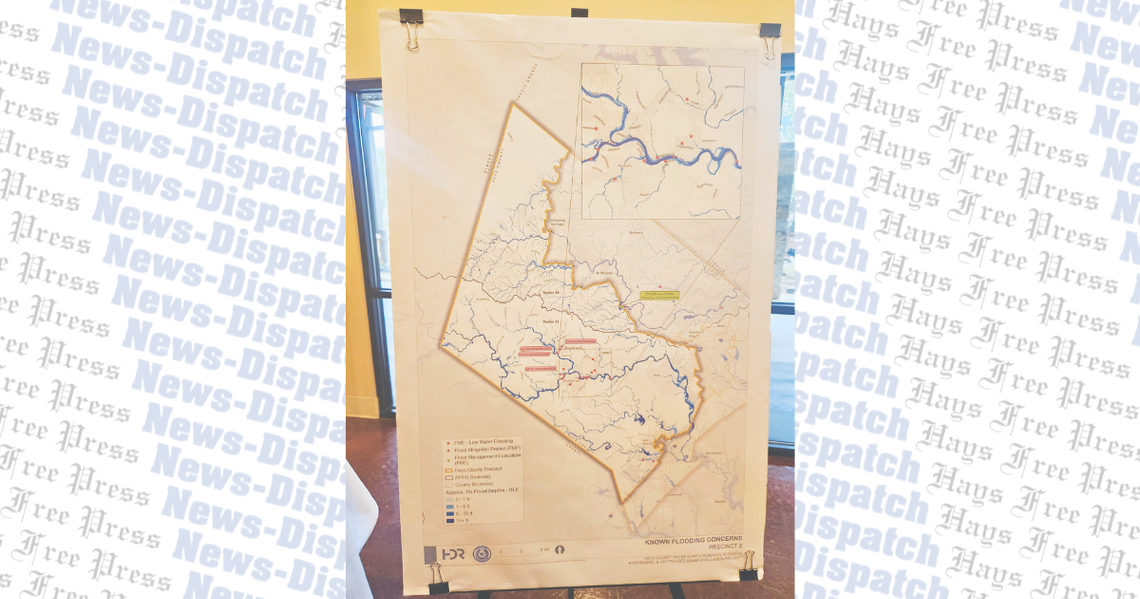
Assess countywide flood risks and develop flood mitigation evaluations and projects
Evaluate sewer infrastructure needs in the Hillside Terrace neighborhood to address aging septic systems and flooding-related failures
Incorporate land-use and development policy impacts on water demand, growth and flooding into planning recommendations
Engage stakeholders across the county to communicate project goals, gather input and build support for future strategies
A specific portion is a localized water supply plan, Thompson explained, where, in Precinct 3, HDR is working with providers Wimberley Water Supply Corporation and Aqua Texas in Woodcreek.
“Working with the two utilities to get a better understanding of their customer base — the number of customers, the type of customers, their type of usage patterns … understanding how much they're producing on a day-to-day basis, how much they produce in a year, understanding their groundwater permits and their other supplies that they may have, whether it be reuse or such ... [helps us understand] how do you meet those needs," he said. "[With] the supplies that you have today, will it get you out into the future? And if so, how far and when you run out of those supplies, how do you supplement?"
Along with the specific area’s needs, as they relate to the water providers, Thompson said they will look at water supply opportunities, conservation and drought management and costs of the projects to develop an implementation to tie it into the regional plans: “A water supply plan developed from the local perspective, feeding back into the regional or the state plans.”
The annual production for Wimberley Water Supply Corporation has had a 37% decrease from 2003 to present day, as well as a 15% decrease since 2020. The water savings are also true for Aqua Texas, Thompson presented, with a 17% decrease since 2020.
“That's what we're seeing based off of data, but what is in the regional plan for the Wimberley area doesn’t quite match. So, [in the Texas Water Development Board (TWDB) 2026] plan, it shows the population in the Wimberley area growing from 3,000 people to 25,000 people,” he said. “We know that hasn't been the case over the last several years because growth is pretty flat. So, we'll look at the growth of customer base for both the utilities, look at their service areas [and] we'll identify kind of a max build out of those service areas, so we can get a bigger picture of what could happen. That way we can plan more appropriately.”
One attendee asked if the decrease shown in the data for Aqua Texas was related to the outdoor watering enforcement. Thompson responded that a reduction in outdoor watering for any utility will cut the numbers for annual production drastically.
There were multiple attendees who asked about groundwater sustainability in the long-term, as compared to rainwater collection, as resources — like the aquifers — have been experiencing extreme stress.
“We are not scoped to go into that greater detail on the groundwater side. We will work with the groundwater districts to identify their permitting, their strategies moving forward, but we are not developing anything new on top of what they're already doing today or what they're planning on doing,” Thompson responded.
Commissioner Hammer, who oversees Precinct 3, added that there are different aspects that come along with the complex issue of water, with policy being a major one, as counties are not given wide authority and the local groundwater conservation district has the least amount of water authority in the state, as granted by Chapter 36.
She continued that the study is “one piece of a big puzzle” and is going to help give a good scope of water supply, as well as be a tool for the county’s rewrite of the subdivision regulations.
“One of those could be potentially increasing the amount, right now, you have to have six acres or more if you're building five lots if you're going to drill a well,” Hammer said. “Maybe we increase that. Maybe this is going to tell us that we don't have the water. It's probably going to, I am just saying that, but these are all the things that are going to help us develop good policy to go to the legislature and to ask for things.”
The final component presented was that HDR will also collaborate with county commissioners and local stakeholders — with an influence from community input — to identify one flood mitigation project in each precinct to help reduce local flood risk and ensure that TWDB project criteria is met.
HDR is working with commissioner Hammer's office to find an online location to post the meeting materials. Feedback and questions can be sent to [email protected].
The public is invited to three more open houses related to the countywide water study, along with localized water supply plans:
Precinct 1, hosted by commissioner Debbie Ingalsbe, at 5-7 p.m. Wednesday, April 29, at the San Marcos Activity Center
Precinct 2, hosted by commissioner Michelle Cohen, at 5-7 p.m. Tuesday, May 12, at McCormick Middle School
Precinct 4, hosted by commissioner Walt Smith, at 5-7 p.m. Wednesday, May 13, at Dripping Springs Ranch Park