 Megan Navarro
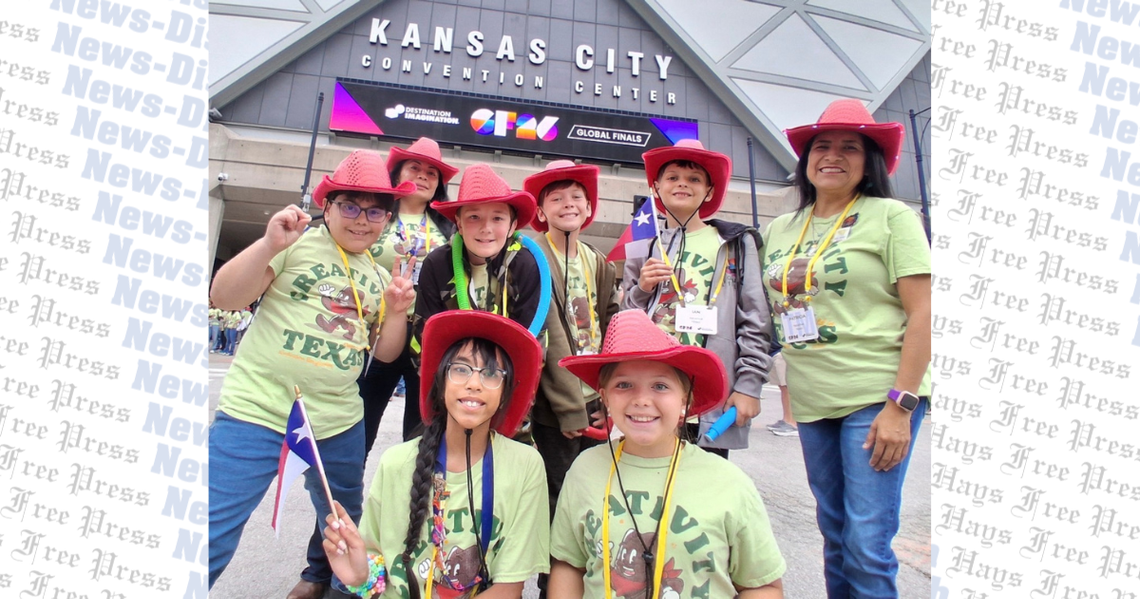
BUDA — After securing third place over more than 60 international groups, Pfluger Elementary School’s Destination Imagination (DI) team is hoping to shine a light on the importance of the program and Science, Technology, Engineering, Art and Mathematics (STEAM) as a whole.
DI — a global community — inspires students to work together in teams to solve open-ended STEAM challenges designed to teach the “creative process,” which is a step-by-step process that helps the students better understand problems and ask better questions, come up with solutions, learn from failure and celebrate their achievements, according to its website. The ultimate goal is to help them feel empowered and prepare them for success in their future.
Locally, the DI program at Pfluger was started five years ago by Dr. Micaela Vargas — a professor in the Department of Biology at Texas State University with her own degrees in cell and molecular biology — and specials teacher Patricia Segura. Though the two are team managers, the program itself is led by the students.
Pfluger’s most recent team for the 2025-26 school year, named Flying Colors, consisted of seven students in the fourth and fifth grade. In order to be on the team, they were required to write a small paragraph on why they were interested in DI, as well as participate in tryouts, where they were paired with another student to see how well they could collaborate together to complete a building task or performance task.
“This year's team is very special because last year, we had three teams and when you have close to 20 kids that you have to manage, you got to make sure that they're following the rules and making sure they're on track,” Vargas said. “It is very, very hard on us. Last year was very challenging and so, we decided this year that we're only going to focus on one team. We had tryouts and we made sure that the team that we were going to build worked well together … and be able to read each other. This is one reason why this team is so special because four of the seven team members, this was their first year doing this program.”
The team has had recent success, securing second place at Capital Region Finals in February, sixth place at Lone Star Finals in April and then, making a name for itself as third-place winners out of 62 global teams at the Global Finals in May.
For the competitions, the DI teams first have to develop solutions to one of the six categories, of which, Pfluger chose technical, to showcase their months-long work in the team challenge. Utilizing the resources that she has as a professor at Texas State University, Vargas was able to have the campus’ chapter of IEEE — an international organization of electrical engineers — mentor the young team, which included her son as the primary tech, during their journey of developing a game show for the challenge.
“I would bring the kids on campus and have them work on campus on their engineering project and develop out their game show,” Vargas explained. “This wonderful collaboration has lasted [with the help of the IEEE] student group mentoring our kids and teaching them the basic techniques of electrical engineering and building out their challenge.”
The second component is an instant challenge, where teams have to think on their feet by solving an unknown, rapid-fire puzzle or engineering task on the spot.
“They'll do a building challenge where they'll lay out some general [STEAM] materials, like pipe cleaners, paper towel rolls, mailing labels, paper and index cards, and they will be asked to create something within five minutes and they're looking to see how quickly they can execute the challenge,” Segura said.
Although they placed well, the road to physically get to the Global Finals in Kansas City, Missouri, was not easy as the team managers, along with parents, had to do the legwork, due to struggles with securing funding with the school district — despite Pfluger being the first Title 1 elementary school in Hays CISD to reach this level.
“I believe in this program so much. We are advocates of this program. It’s not as big of a push in the district as it used to be when it first got started and, I think, after COVID, it kind of just dwindled down and now, we are losing a lot of funds in our school district,” explained Segura, who was involved in DI even before her time at Pfluger.
She added that DI is important because it lays down the foundation of early STEAM skills for students, as well as helps them navigate a passion for these, as they continue throughout middle and high school levels.
“I’ve seen them literally grow, have confidence in themselves, have a voice and be leaders within their team. I've had parents come up to me and basically tell us, ‘This is what you did for those kids,’” Vargas said, holding back tears. “This is so important and I really do believe in this program.”
Going into the next school year, the team will look a little different, as some of them are now moving on to the middle school level and won’t be competing with each other. However, Vargas and Segura are still looking to a bright future in advocating for the vitality of the DI program at Pfluger.
“These scientists and engineers are bringing the future and this is why I need these kids to challenge themselves because they are the future,” Vargas concluded.
To learn more about the global DI program, visit www.destinationimagination.org.