Go to main contentsGo to main menu
Saturday, July 25, 2026 at 7:53 PM
Ad

Meadows Center shares San Marcos River history

Meadows Center shares San Marcos River history
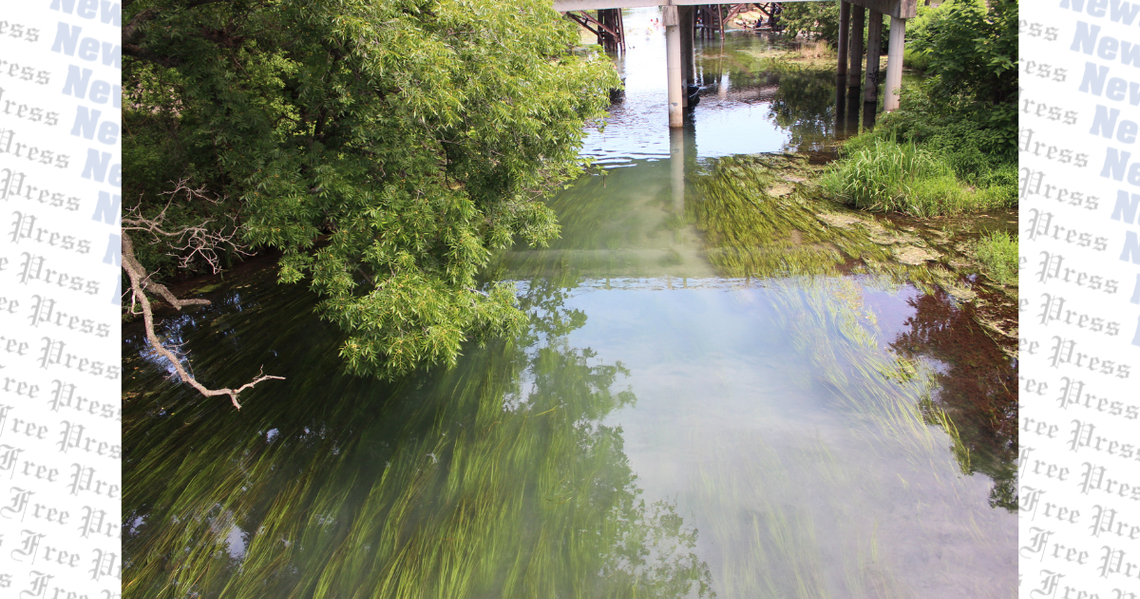
The San Marcos river is a naturally-occurring, spring-fed water resource that is loved by many. The water is at a consistent 72 degrees year round and provides a home to several endangered species, including Texas Wild Rice, pictured.

Author: PHOTO BY BRITTANY KELLEY

SAN MARCOS — The San Marcos River is loved by many in Hays County; however, some may be unfamiliar with its rich history and specifics. As a result, Miranda Wait, deputy director of Spring Lake education at The Meadows Center for Water and the Environment, shared her knowledge in hopes to inspire those to love and protect the water source a little stronger.

Geographically, the naturally-occurring, spring-fed river’s history begins long ago, said Wait, when there was simply an ocean, until a giant earthquake occurred, forming the Hill Country. The humans came later, but still inhabited the location for centuries, spanning back 12,000-13,000 years ago, confirmed by Clovis points found by archeologists in the area. These are stone spearheads known to be crafted by Paleo-Americans — some of the oldest humans in North America, Wait explained.

Spring Lake is the river’s headwaters, serving as a direct connection to the San Marcos Springs. Located on the historical Spanish route El Camino Real de los Tejas, or the King’s Highway, this and the area surrounding it is one of the nation’s “persistently inhabited places,” as there weren’t any settlements in the area for a long period of time, but travelers and traders often visited, due to the water source.

Early Spanish explorers actually believed that they had discovered the Fountain of Youth, said Wait, most likely because of the remarkable experience: bubbling water at Spring Lake, with consistent 72-degree water. Though, another group of individuals have a different connection to the headwaters.

According to the deputy director, the Coahuiltecan people believe the springs and the Balcones Fault line — seen at the bottom of the springs — to be the origin of their story.

Ancient cave pictographs on the White Shaman in Comstock depict five dots, all of which line up with the springs of Central Texas — Barton Springs, Comal Springs, San Pedro Springs, San Antonio Springs and, finally, the San Marcos Springs — said Wait. The latter has imagery coming from it, which has been interpreted as the creation of the Coahuiltecan people.

“This space is a sacred space. People [have been] coming here for thousands of years. We’re not even allowed to dig more than six inches out here without having the Center for Archeological Studies out here because we’re going to find something no matter where we dig. So, I think San Marcos is very unique with that,” she said. “We have a set of springs that have never gone dry.”

The river eventually had settlers in the 1800s, when General Edward Burleson set up his homesteads at the headwaters of the river, said Wait. He would be the one to introduce a resolution to establish Hays County, according to the Texas State Historical Commission.

Burleson eventually sold his home to the Rogers family, who is known for constructing Aquarena Springs, the beloved theme park.

Aquarena Springs opened in 1951 and boasted a hotel, glass bottom boats, a submarine theater, an Alpine Swiss Sky Ride and, most notably, Ralph the Swimming Pig and mermaids aka Aquamaids.

“I think in the '70s [and] '80s people really got active, going outside, doing all these weird things, like coming to Aquarena Springs, seeing the swimming pig, seeing the mermaid shows, [but] in the early '90s, people started questioning some things and that’s when things changed here at Spring Lake,” stated Wait.

Some may assume that the river and springs are fed through the Austin portion of the Edwards Aquifer, but Waits noted that it is actually a segment in the San Antonio region. Because of this, infrastructure in the Southwest directly affects the springs.

She noted that the environmentalists realized that the water needed to have protections, due to endangered species. Wait shared that this, the San Antonio infrastructure boom and the oversaturation of amusement parks, such as SeaWorld San Antonio and Six Flags Fiesta Texas, likely contributed to the eventual closure of the theme park in 1996.

Texas State University purchased the park in 1994 and opted to shift its focus to education, rather than entertainment.

Although there have been more efforts to protect the river and the species that call it home, pollution became a large issue as the university began to grow.

A survey done by the organization revealed that 95% of the student population chose the school based on the river.

“This water is supposed to be very clean. We always used to say, ‘This water is 10 times cleaner than EPA standards,’” recalled the deputy director. “I don’t know if that’s correct anymore, but looking at [a 2016] report, there’s all sorts of things in Spring Lake. It’s antidepressants, [per- and polyfluoroalkyl substances (PFAs)], a cocaine derivative, birth control, all that stuff is already in the water. Whenever it rains, things get washed into the recharge area [of the aquifer], get settled down and that gets pushed up in the springs.”

The test mentioned was in 2016, but there are still new issues arising, such as lighters or vapes that are found in the water source. She recalled being in her 20s at the river and seeing students throw cans in and laugh: “There definitely needs to be a little bit more of a reform on education on liberal stewardship.”

This year, the city of San Marcos opted to have restricted access to Rio Vista Park, which Wait hopes will help with littering. In turn, the species that reside in the river will have a safer home.

“It’s definitely a pretty healthy ecosystem, whenever you take away all the human traffic. I don’t think the solution is to get rid of recreation. People need to have those kinds of connections to feel something for nature. So, I definitely think recreation is fine; we just have to start educating people,” Wait emphasized.

Spring Lake provides a critical habitat for endangered species, as they prefer the 72-degree clean water, correct pH levels and fast currents, all unique to the San Marcos River. These species include the Fountain Darter, San Marcos Salamander and Texas Wild Rice, said the deputy director.

Those at the Meadows Center and other organizations are constantly learning more about the river, according to Wait. Currently, there is a study going on about the Fountain Darter and a continuous Upper San Marcos Habitat Conservation Plan to manage the environment and conduct plan surveys, remove trash, plant new strands of native species and more.

“I think the best thing is to leave it better than we found it. So, picking up after yourself whenever you leave the river, packing out what you brought in … Just know that you are not the only one using the river. There are other people, but then, there’s also fish and wildlife that depend on that water,” concluded Wait, adding that community members should fight against housing developments and data centers that take away from the springs.

To learn more, visit www.meadowscenter.txst.edu.

More about the author/authors:
Share
Rate

Ad
Check out our latest e-Editions!
Ad
Ad
Ad
Ad
Hays Free Press/News-Dispatch Community Calendar
Ad