

 Brittany Kelley
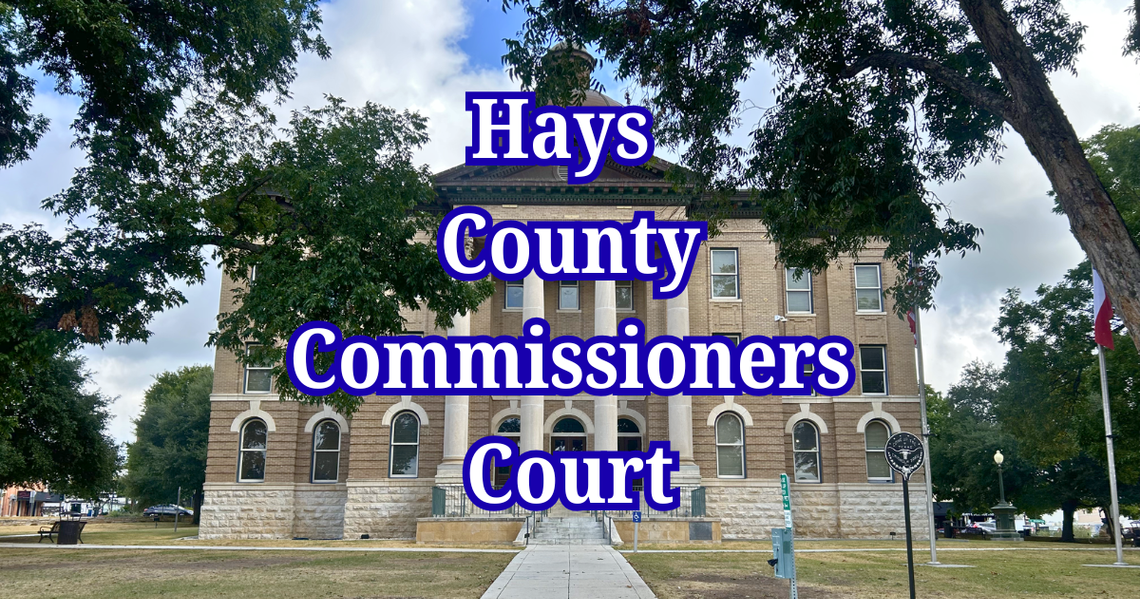
SAN MARCOS — The Hays County Commissioners Court finalized its budget and tax rate at the Sept. 15 meeting, which included eliminating the Axon Era artificial intelligence (AI) plan.
“It’s been a long road, but I think we’re seeing the light at the end of the tunnel,” said budget officer Scot Woodland.
This would be the final reading for commissioners to make any adjustments. Ultimately, after being brought forward, both the New World ERP software upgrade and bilingual pay for civilian roles were not approved.
Commissioner Debbie Ingalsbe then began the discussion for the Axon Era AI contract.
The contract consists of more than 15 items that use AI to aid the Hays County Sheriff’s Office, including translation abilities, smart capture, video search and more. Funding for the first year of the 10-year contract was approved at the Sept. 1 meeting, though community members shared their opposition to the service. Because of this, Ingalsbe began researching the issue herself.
“I specifically looked at the translation piece of this because that was the demonstration that was given in court. That’s what I thought we were looking at, is more the translation … but when I went and researched, what really concerned me was the direct court inadmissibility area section that I came to,” said Ingalsbe. “Axon openly acknowledges that its translation software is not ready for the courtroom.”
Transcripts and translation are unverified until human review takes place, she continued: “It just seems like we’re not really getting anywhere, if we’re still having to use a certified interpreter, but then, we’re adding this cost on top of that.”
Prior to budget discussion, Hays County Sheriff Anthony Hipolito, Chief Deputy Brett Bailey and First Assistant District Attorney Gregg Cox took to the podium to state that the AI contract from Axon is not similar to Flock Safety and advocate for its necessity, as body camera footage is used in criminal cases, as well as to contribute to the safety of residents.
Bailey noted that this service was never intended for court use, as it’s mainly to communicate with the public, most of which never sees the inside of a courtroom.
Commissioner Michelle Cohen agreed with Ingalsbe’s sentiments, as she feels as though the county needs to have a policy regarding AI prior to approving this item.
Efficiency is the main purpose, said Cox, as the AI can act as a guide in videos, allowing for less staff to sift through them and for the officers to write better reports. Additionally, this could speed up trial cases, as it will take less time to go through evidence: “The volume of video that gets produced on cases now is enormous and without tools like this, I don’t know how we can do our jobs.”
“This is a place holder for funds to potentially look into a contract and potentially agree to these terms and conditions. I would be happy — because there’s some people in the court that want to look into things further, look into different companies and whatever that looks like — to move forward with that funding, but just putting it under software for the sheriff’s office. So, if they were able to find another company or whatever have you, we have funding there and if we never use it, we can move it into some other category,” suggested commissioner Morgan Hammer.
She then motioned to place the funds for the Axon AI contract currently in the budget under HCSO’s software line item, amounting to approximately $97,000. The item failed 3-2, with Hays County Judge Ruben Becerra and commissioners Ingalsbe and Cohen dissenting.
Becerra then motioned to remove the funding for the AI Axon plan and instead allocate it to two correctional officers, which, according to Hipolito, were sacrificed in order to adopt the plan. The item passed 4-1, with commissioner Walt Smith dissenting.
After these changes, Smith motioned to approve the budget, along with changes made. The motion was approved 3-2, with Hammer and Becerra dissenting.
During discussions of the tax rate, the court opted to cut several positions, including:
• Associate judge
• Juvenile diversion coordinator
• Justice clerk
• Assistant auditor, payroll manager
• Assistant Human Resources director
• Tax specialist
These cut positions, along with other items not funded, amounted to $1.3 million that would be in reserves, compared to the original $333,000.
“If we were to keep that $333,000 in [our reserves], then the tax rate would come out to 1.0592 [cents increase]. If we were to take that $333,000 out, then it comes out to a 0.9827 [of a cent increase to the] tax rate,” said Woodland.
Currently, the tax rate is at $0.3999.
“When you think about next year, we already have $6 million accounted for that we’re going to have to figure out,” said Hammer. “I don’t support an increase period, right? But if the way to do it was to — from a tax perspective — [set] us up for success next year, it would be to put this money in the reserves currently and to maintain that reserve balance.”
Smith added that even with this increase, the average homeowner would still see a $8 decrease in their taxes paid.
He then motioned to adopt the tax rate increase of 0.9827 cents, for a total of $0.4047, which includes pulling $333,000 from the reserves. The item passed 3-2, with Hammer and Becerra dissenting. However, after approval, Woodland stated that he “did not move over the half cent from the road and bridge [funding] when adding [the numbers], so it would actually come out to be $0.4097.”
Following this, Smith motioned this time to adopt the tax rate of $0.4097, which is “an increase of $0.9827 for fiscal year 2027” from the current tax rate. The motion passed 3-2, with Becerra and Hammer dissenting once more.
Later in the meeting, Smith said that they had to reopen the item to vote on the tax rate again because he stated that there would be an increase of $0.9827, when “it’s an increase of $0.09827.” This time, it passed 3-2, with Becerra and Hammer dissenting.
Although approved by the court, the increase from the previous year’s rate is actually $0.009827.
The final vote to approve an order to set the tax rate for fiscal year 2027 at $0.4097 per $100 valuation passed 3-2, with Becerra and Hammer dissenting.
To listen to the full discussion, visit bit.ly/4Ak0hTN.







