 Lance Winter
SAN MARCOS — What Holly Veselka first took for dirt and debris on a dismantled oil rig turned out to be evidence of a world she had not yet seen.
The San Marcos artist was visiting a decommissioning site in Shetland, Scotland, an archipelago located in the North Atlantic Ocean, when a worker appeared carrying a large cold-water coral. After she admired it, he brought her a smaller piece to keep.
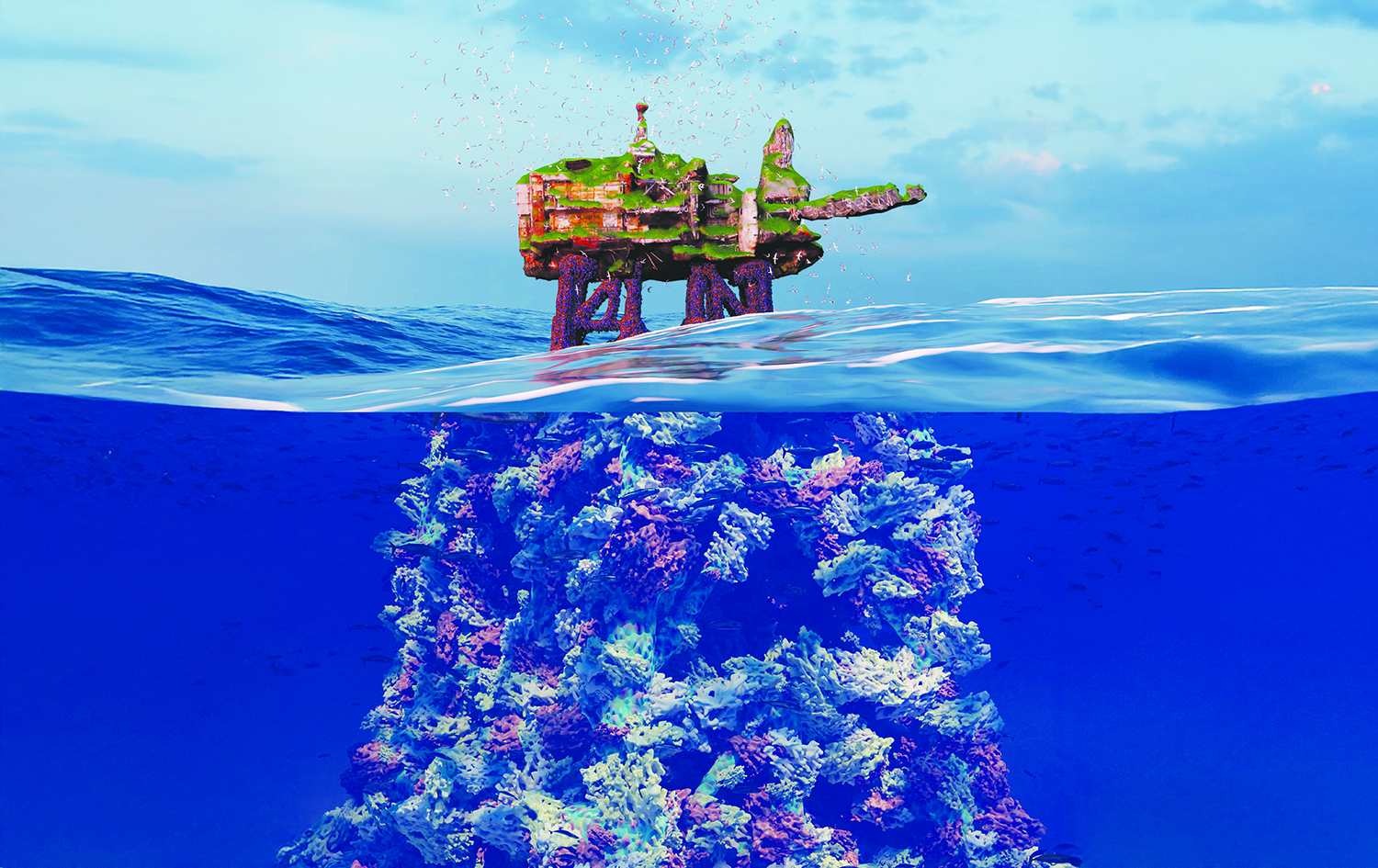
Suddenly, the material covering the rig’s steel framework took on new meaning. It was coral skeletons — remnants of marine life that had made an industrial structure its home.
That discovery, and the complicated emotions that followed, helped set Veselka on a creative journey connecting offshore energy infrastructure, the waters of San Marcos and a friendship spanning an ocean.
Her latest work, “H.O.W.L. (Hybrid of Oceanic World Loops),” will bring those connections to five screens at the AURORA Biennial in Dallas. The installation will be on view during the free outdoor exhibition from 7 p.m. to 1 a.m. Nov. 21, in the AT&T Discovery District. Veselka plans to be there throughout the evening to talk with visitors.
For her, the work asks what becomes of the things people build, the relationships they form and the traces they leave behind.
“I hope viewers will consider how our actions become part of other lives, often in ways we never intended,” Veselka said. “What we build and leave behind continues to shape the world.”
Veselka traveled to Shetland through X-Change, an artist exchange between the McNay Art Museum in San Antonio and Shetland Arts. The exchange connected Texas and Shetland through their changing energy economies, including oil, gas and wind.
On her first evening, Shetland Arts program director Jane Matthews and artist Shona Main told her about the decommissioning site. The enormous structure on land, they said, looked like something from a science-fiction film.
“Around the [rig’s] jacket were mounds of dead marine life almost as tall as me: mussels, sponges, starfish, crabs, sea spiders and corals,” she said. “Our lively conversation became somber.”
One person called it a graveyard; another called it ecocide, yet Veselka also saw something that complicated the devastation: Life had found a foothold on infrastructure built to extract resources from the sea.
Later, at an artist talk, she shared specimens and described imagining an abandoned rig as a protected habitat and monument to energy transition. A former rig worker became emotional, speaking about his love of the waves, weather and seabirds, his pride in providing energy and his struggles with pollution.
He too, found hope in the life that had grown there.
The encounter informed “The Rig,” her 2023 video artwork. Using photogrammetry, a process that constructs digital models from photographs, Veselka recreated the rig and its corals and placed them in a simulated ocean.
“H.O.W.L.” expands that exploration, setting it within an ocean in motion.
Originally from Houston, Veselka moved from Brooklyn to San Marcos to teach. The region’s water has become a source of personal and artistic connection, which relates to the new installation, where people place objects into water on screen. These objects travel across the screens, changing as they encounter marine life, energy infrastructure, islands, wind turbines, garbage and algae.
That gesture grew from a conversation with a member of the Indigenous Cultures Institute, who described a summer ceremony of placing prayers into water and spoke of those prayers traveling downriver, into the Gulf and across oceans.
“The idea of giving spiritual intention to water and allowing it to travel between continents deeply moved me,” Veselka said. “It offers a hopeful way to imagine how giving in one place connects to receiving in another.”
The ocean also carries a more intimate connection for Veselka, as two years ago, when Matthews and Main visited Texas for Main’s exchange, their travels included Spring Lake in San Marcos and oil and gas refineries along the coast.
The group often talked about the Gulf Stream connecting their homes. They imagined water from Spring Lake eventually reaching the beach near St. Ninian’s Isle — an island in Scotland, close to Main’s home — and discussed how climate change might disrupt that connection.
Main died last fall.
“In H.O.W.L., the Gulf Stream represents several kinds of connection: between planetary systems and climate change, between people sending intentions and those receiving them, and between friends,” Veselka said. “Those connections can persist, disappear, change or reappear even after someone has been lost.”
Veselka is constructing the ocean in a game engine, drawing on her Shetland experiences, research and reporting about offshore oil and gas infrastructure in the Gulf and fictional stories about the Gulf Stream.
The five screens will be staggered in a sculptural arrangement that loosely references offshore energy infrastructure. Objects will move between them, passing above and below the water as their surroundings change.
The installation joins AURORA’s “States of Becoming” Biennial, which runs Nov. 4-21 across North Texas and concludes with the free outdoor exhibition in downtown Dallas. Curators Julia Kaganskiy and Tairone Bastien sought work addressing a world undergoing ecological, technological and political transformation.
For Veselka, that transformation leaves room for both grief and possibility.
“In H.O.W.L., destruction and renewal unfold together and the future remains uncertain,” she said.
Her hope rests in life’s ability to form new relationships — whether organisms turning a rig into an ecosystem or chance encounters becoming lasting friendships.
“And I want to ask what responsibility we have to recognize and care for those relationships,” she said.
For more information on the AURORA Biennial, visit www.dallasaurora.com.