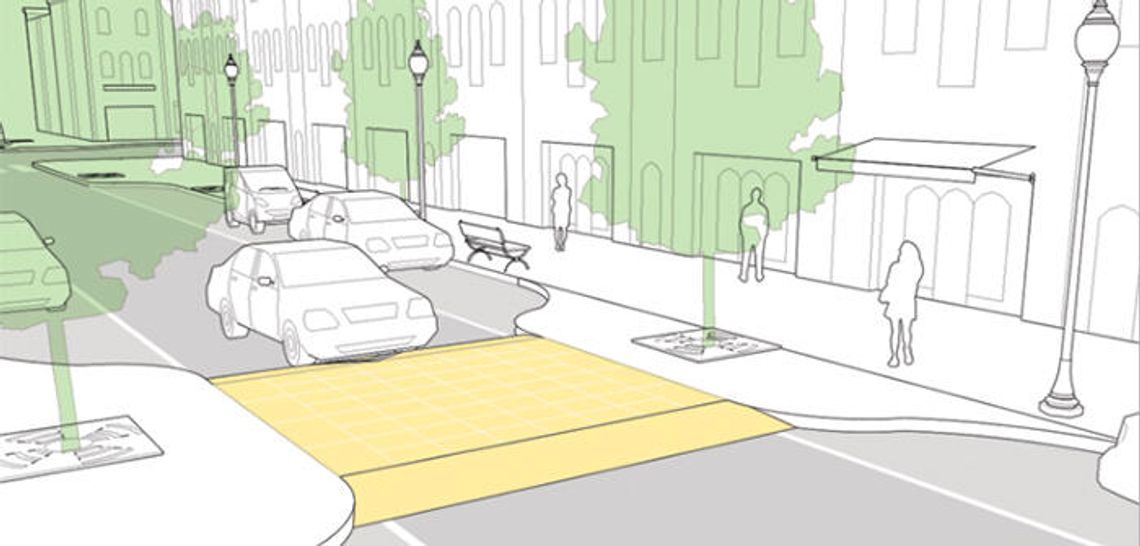
Hays County Commissioners Monday opted to delay action on a possible traffic calming policy in order to gather public opinion on the matter.
Commissioners voted 5-0 for a public hearing in two weeks on the policy, which according to officials would be for use across Hays County.
Jerry Borcherding, Hays County director of transportation, said the policy was crafted in order to create consistency for the installation of traffic humps, speed bumps and tables.
Adam Leach, assistant director of transportation, said one of the more common requests to the transportation department is for speed bumps and tables in county neighborhoods.
Hays County’s model would require additional feedback from neighborhoods, as residents “would like a little more buy in, so to speak, in the process,” Leach said.
According to a draft of the policy, a traffic study must be requested by a resident along an affected street and must also have signatures from 10 percent of residents.
Citizens who live in areas governed by a homeowners association or live on roads maintained by the county inside incorporated city limits must send requests to their local governing body.
Requests, however, wouldn’t be considered for county collector, arterial roads or country lanes that service less than 20 homes.
Leach said the county’s transportation department would conduct the traffic study, which would assess speed based on the 85th percentile, similar to what the state uses for traffic studies.
According to the Texas Department of Transportation website, the percentile is based on the theory that a speed at or below which 85 percent of people drive at any location under good weather and visibility conditions is the maximum speed for a location.
After conducting the study, Hays County will determine whether the road warrants a traffic calming measure based on several criterions. County transportation officials will issue a recommendation to the resident and to the respective commissioner’s precinct office for review.
From there, residents have 30 days to request action from the transportation department to install a traffic calming measure. Requirements include obtaining 20 percent of signatures from residents on the road for rumble strips or buttons and 51 percent for speed tables and roadway construction.
Leach said it would avoid a single resident from possibly implementing a traffic calming measure that may be unwanted by other residents.
If a traffic calming measure were to be removed, the county requires 51 percent of residents on the road to remove it at the cost to the county, if county officials recommended it.
However, measures that were not recommended by the county would need 75 percent of resident signatures and must be funded by the residents.
Hays County Pct. 1 Commissioner Debbie Ingalsbe said she believed the policy was good to have. But she also advocated for a public hearing to gather feedback.
“If we’re going to allow devices to be placed, it’s good to have a policy in place and be consistent within the county,” Ingalsbe said.
Hays County Pct. 3 Commissioner Will Conley did not support the policy as he felt the system the county has works “quite well.”
He said his precinct is extremely diverse and has a “million different conditions.” He believes Pct. 3 has been responsible in applying traffic calming devices, as they have a policy they have followed for a ‘long time.” He said the current policy allows for flexibility.
“I’m not willing to secede that design and set up,” Conley said. “I think it works quite well and I think it’s a perfect mixture of direct representation of the people we represent and a responsible department that’s maintaining a countywide system.”