 Brittany Kelley
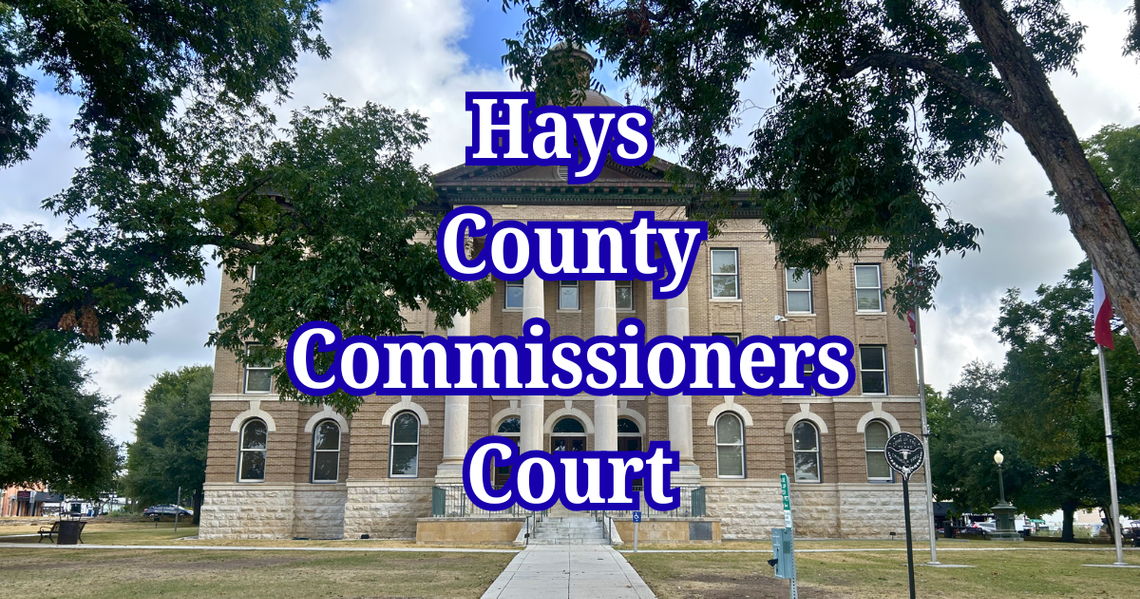
SAN MARCOS — The Hays County Commissioners Court discussed the beginning of fiscal year 2027 at its Aug. 4 meeting.
First, the court discussed several efforts for the upcoming budget, which was brought forward by Hays County Judge Ruben Becerra.
“The reason I created this agenda item … [is because I have] elected officials and department heads asking for direction, asking for support. They’re running their entire departments and they’re waiting to anticipate projects and everything else. So, what I hope to accomplish with this agenda item is to give public, open roadmapping as a compass for not only our budget office, but for also the viewing public to understand what our goals are and what our aim is,” said Becerra.
The item read that these efforts could include freezing the hiring of full-time employees, reducing inmate relocation to less than 50, school resource officer (SRO) costs, American Rescue Plan Act (ARPA) positions, a pause of studies and masterplanning, housing out of county juvenile inmates and postponing data conversions and software updates.
Commissioner Walt Smith said they made a commitment when creating the ARPA positions, so they need to carry those forward. Additionally, he shared that when they created the Parks and Open Spaces Department last year, they made a strong commitment with how the department should expand. Because of this, he does not want to remove personnel from current park projects, such as Sentinel Peak, resulting in the inability to open these experiences up to the public.
Scott Woodland, budget officer, noted that he was able to find interest earnings in ARPA to keep the employees, but that next year, they will have to be moved out.
He also stated that he’s discussed SROs with Hays CISD, where he learned that the district is planning on supporting additional officers at each campus in its budget.
“It is something we always wanted to step up and assist with in the past and I think I would be supportive of that,” said Smith, noting that the county originally asked to aid with SROs, but the school district denied the offer.
“I know it is a very tight budget year and my direction has been, ‘Let’s look at a tax rate increase and see what that looks like,’ but I also believe we need to ensure we are still giving the resources that our departments need to function well,” said commissioners Debbie Ingalsbe. “I think it’s going to be a lean year and we need to look at that as we move on into the budget.”
Regarding a freeze, commissioner Morgan Hammer stated that there “is a time and a place for it,” but that the court has set a precedent that there needs to be data and justification when asking for a new position and many departments do not achieve this.
According to Becerra, he discussed the Haskell inmate outsource with the Hays County Sheriff’s Office and discovered that the number of outsourcing is decreasing, so limiting it to less than 50 inmates is possible. Ingalsbe shared that she would like to start back up contracts with neighboring counties to house inmates, since it would be easier for representation and families, if they were closer. However, Smith said that these counties have also had exponential growth, so they may not be able to take in extra inmates from Hays County.
Becerra is looking to do the opposite of what the county’s partnership with Haskell is, with the juvenile center.
“The conversation behind that is to have the opportunity for all the empty space, in reverse of the adult portion that we deal with, but in the juvenile side [by] help[ing] neighboring counties and, ultimately, I’m hearing, make some money out of it,” said the judge.
“Everybody hold your breath, this is something we’re going to actually really agree on. I’m not joking,” stressed Smith. “We are currently housing juvenile inmates from all the surrounding counties. The daily rate on those is actually pretty good; I want to say it’s $350-370 a month, something like that, as opposed to $102 that we’re paying in Haskell. There are different standardizations and those types of things that we have to have, but given the growth of our county. I thought we missed something in our Capital Improvement Plan whenever we didn’t look at the juvenile facility that we have.”
The facility will probably need an expansion in five to 10 years, he continued, so bringing in additional inmates from other counties would likely pay for the expansion over the years.
Joel Ware, juvenile facility administrator, was opposed to this idea, as he stated that it would change the morale for staff: “You have to be built to handle more behavioral problems. You have to be built to handle more health problems. So, taking in more out-of-county kids [than we already have] — unless there is an investment made to the facility — when you’re talking about operations, appliances, you have to be able to deal with those everyday problems. It is tough.”
As for pausing studies and master plans, the court opted to have a list of ongoing projects brought before them, prior to deciding.
Woodland also noted that he asked the Information Technology Department what data and software updates were needed and only included those in the budget. So, no unnecessary updates will be done.
Moving on to the budget presentation, Woodland stated that he chose to work without an increase in property tax — so it would stay at $0.3999 to determine what the county could “get by with,” though this resulted in a lot of denials to requests, such as new positions, forklifts, camera drone, freezer equipment and more. He did note that with a tax increase, all of the requests could be fulfilled.
Some capital assets that Woodland felt were important and, therefore, included were high mileage vehicle replacements, air conditioning unit replacement at the Hays County Jail and Juvenile Detention Center, fire investigator equipment, ADA compliant contraction and remodels and property enclosures around a cave that has been deemed a danger. He stated that he focused on giving equipment that promoted safety and reduced potential liabilities.
Expenditures are increasing, he said, with insurance rising 8.5%, more vertical debt payments and increased contract costs.
“In order to make the general fund work [without a tax rate increase], we pulled a half penny from the road and bridge maintenance and operation (M&O) rate to move over to the general M&O. That is a bandaid. That is not something that will be sustainable,” he emphasized, adding that he built in $2 million for the road and bridge budget, which he hopes does not have to be used. “What I wanted to do is lay a couple million dollars into the road and bridge fund. If it is needed, I want to use it there and that way, we know it’s covered and it’s not something I’m going to have to find down the road.”
The county held another budget workshop Aug. 11 — which will be covered in the Aug. 19 edition of the Hays Free Press/News-Dispatch — and will hold a public hearing Aug. 18, prior to adopting the budget in September.
“It is going to be tough and we are going to have to make some decisions that may not be popular, but we know we are in a tough year. We tried the best we can to have that balance and provide the services that we need,” said Ingalsbe. “I look forward to more in-depth discussion with our colleagues and to seeing what the best route is to take with all of this.”
To listen to the discussion, visit bit.ly/4g44lyf.