 Brittany Kelley
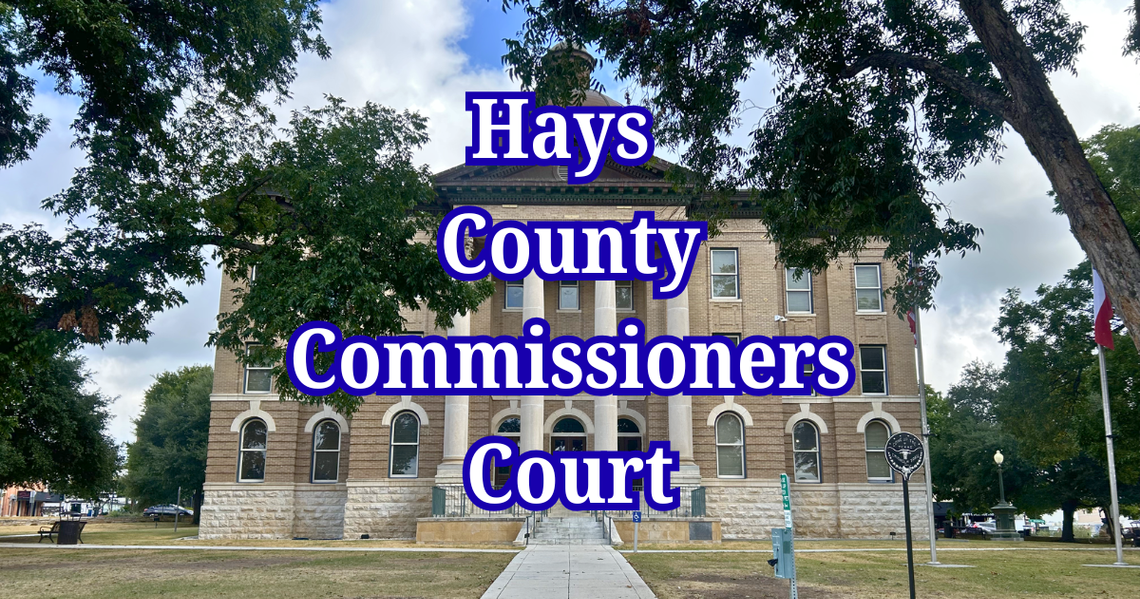
Budget director Scot Woodland provided the Hays County Commissioners Court with a presentation discussing the proposed tax increase for the upcoming fiscal year at its Sept. 8 meeting.
Woodland explained that there are three ways to fund expenditures in the county, either through property tax revenue, cutting expenditures to make room for new ones or using reserve funding, though he expressed that property tax is more sustainable.
Currently, the tax rate is $0.3999, though the proposed tax rate for FY 2026-27 is $0.4125 per $100 valuation, said Woodland — a $0.0126 incr ease. The no-new-revenue tax rate — which is a rate that would provide the same revenue amount as the previous year’s rate — sits at $0.3714. Finally, the voter-approval rate is $0.4926. Adopting a tax rate higher than this would require an election, he said.
According to agenda documents, the average homestead taxable value in Hays County decreased in 2026 and is $433,263. This means that the average homeowner would pay $1,787 for taxes with the proposed increase, compared to $1,744 in 2025, a 2.46% incr ease.
“What the purpose of property taxes are, in my view, is really to determine the services that the county is going to provide. If you want to offer the essential services, what is required, then you can keep that property tax rate on a relatively low scale. If you want to go above and beyond and provide additional services or provide enhanced services, then the discussion needs to be had of where those funds are going to come from and that’s where potentially property tax would come into play,” said Woodland.
He noted that the indigent healthcare and law enforcement numbers have “increased substantially.” This includes basic healthcare and legal counsel for low-income residents. Spending money on indigent care, continued Woodland, provides the capability to raise the no-new-revenue rate, meaning that the county has $0.666 to increase. However, this would require increasing the tax rate.
With the proposed tax rate increase, approximately $133.5 would be generated for the general fund, $50.5 million for the debt service fund and $18.5 million for road and bridge fund, totaling $202.5 million, said Woodland.
Commenting on the indigent costs was commissioner Walt Smith, who stated that to have these courts successful, there needs to be investment.
“I think the commitment that we made to the specialty courts — mental health court and the veterans court — I think we made those commitments knowing that there would have to be some budgetary or fiscal impact over time,” said Smith. “But I would say that there are a number of those other courts that we’re not funding right now at the rate or the focus that we’ve set with the commissioners court.”
Woodland echoed these statements, stating that initial funding is needed to get them started, but that overall, they are advantageous and will most likely see cost savings in the long run.
Commissioner Debbie Ingalsbe mentioned American Rescue Plan Act (ARPA) funding and the fact that it has to be spent by the end of the year. According to Woodland, the county received an estimated $44 million and the Auditor’s office is working on allocating it, but the interest generated has no deadline. So, some of these funds are being budgeted.
“The reason I bring this up … [is] the only housing stability program we have currently right now is Southside Community Center. I know we increased their funding, but if there is that opportunity, I certainly would like to take a look at maybe increasing their allocation with ARPA funding,” said Ingalsbe.
Agreeing with the idea, Woodland did note that it would have to wait until payments are complete to see what is left over.
No action was taken, as the item was informational. The Hays County Commissioners Court held its first of two public hearings on the tax rate Sept. 15.
To listen to the discussion, visit bit.ly/4xD6bNv.